Republic Day at NewAge World School
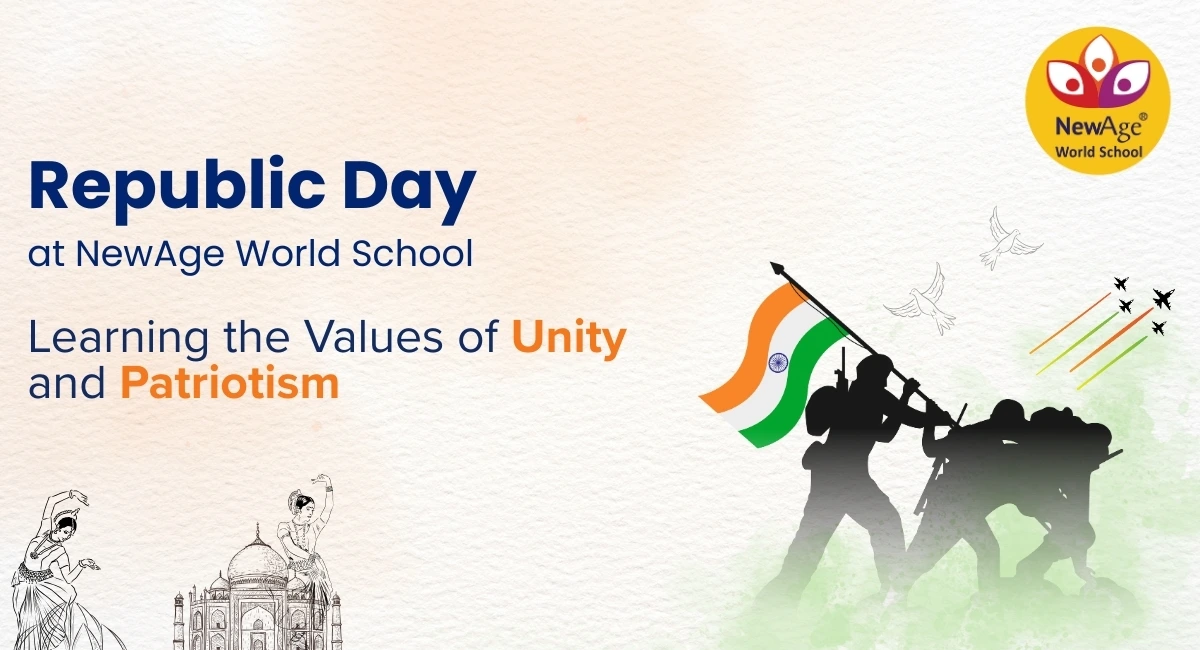
Table of content
introduction
Conclusion
Introduction
India is a vivid canvas of saffron, white, and green every year on 26th of January. Republic Day commemorates the moment we actually took control of our own destiny by ratifying the Indian Constitution in 1950 and proclaiming India as a Republic. Before independence, India was governed by the Government of India Act, 1935, which did not fully reflect the needs, values, and aspirations of the Indian people. Therefore, it became necessary to frame a constitution that would guarantee justice, liberty, equality, and fraternity to all citizens and establish India as a sovereign, democratic republic.
To draft the Constitution, a Constituent Assembly was formed in 1946 under the Cabinet Mission Plan, consisting of representatives from different regions, communities, and political backgrounds to ensure wide participation. Dr. B. R. Ambedkar was appointed Chairman of the Drafting Committee because of his deep knowledge of law and strong commitment to social justice. The Constituent Assembly studied the constitutions of several countries, including the United States, the United Kingdom, Ireland, Canada, and Australia, and adopted suitable features from them.
Over a period of 2 years, 11 months, and 18 days, the Assembly held detailed discussions, debates, and revisions, carefully examining every article to suit India’s unique social and cultural conditions. The final draft of the Constitution was adopted on 26 November 1949, which is now celebrated as Constitution Day, and it came into effect on 26 January 1950 to honor the declaration of Purna Swaraj (complete independence) made in 1930.
Republic Day is celebrated with a grand ceremony in the capital city, New Delhi. Kartavya Path (formerly Rajpath) in New Delhi is the center of the festivities. The Prime Minister lays a wreath at the National War Memorial to start the celebrations, which are followed by a number of activities that highlight India's "Unity in Diversity." The National Anthem and a 21-gun salute come after the President of India unfolds the Tricolor.
One of the most important parts of the Republic Day celebration at Rajpath is the Republic Day Parade. The Army, Navy, and Air Force regiments all march in perfect unison. In addition, the demonstration of native tanks and missiles, as well as the stunning display of fighter jets, helicopters, and transport aircraft in precise formations reflects the pride of the country.
A major attraction of the parade is the cultural tableaux - Jhinkis (floats) presented by various Indian states and union territories. Every float conveys a narrative, whether it is about a technological advancement, a historical event, or a traditional dance. Gallantry awards are also presented by the President to members of the armed forces and civilians who have shown exceptional courage and selflessness. These awards remind citizens of the sacrifices made to protect the country and encourage young minds to serve the country.
We all want our children to grow up with a strong sense of patriotism and respect for their country. One way that we can help students develop these values is through Republic Day celebrations in schools. Republic Day is more than just a public holiday or a day off from school; it is a significant day in our nation's history that honors the ratification of the Indian Constitution. By taking part in Republic Day celebrations in the classroom, students have the opportunity to learn about the values and tenets upon which our country was founded.
At NewAge World School, Republic Day was celebrated in the assembly with patriotic songs and a skit highlighting India's unity and diversity. A quiz was also conducted through whichs tudents gained knowledge about the nation's history and democratic system.
Conclusion
In summary, the Republic Day celebration was a wonderful occasion that perfectly captured the spirit of unity and patriotism among the faculty and students. Let's uphold the principles of democracy, equality, and justice in our day-to-day existence as we consider the significance of Republic Day. In order to create a better and more promising future for our country, let us endeavor to uphold the values found in our constitution.

Vimala.B
Department of Social Studies
















Leave a Reply
Your email address will not be published. Required fields are marked *
Comments
No comments available