Assessment at NewAge World School | Fear-Free Learning
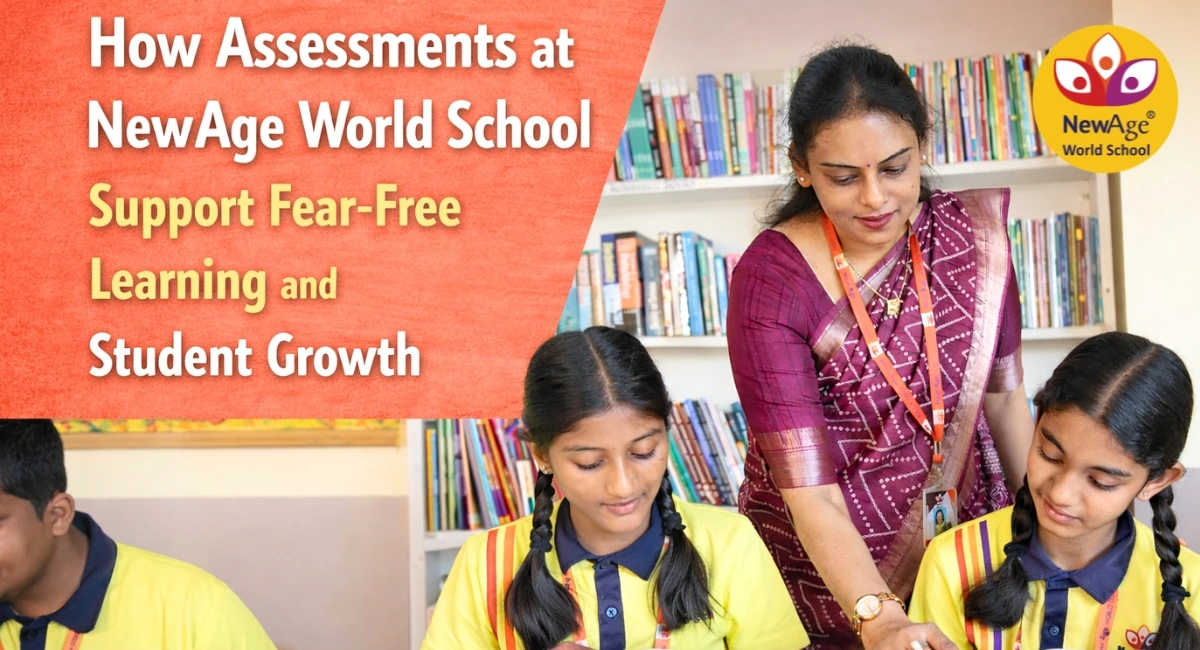
Table of content
Introduction
Types of assessment
Grades 1 to 4
Grades 5 to 10
Grades 9 and 10
Conclusion
Introduction
Assessment is a vital part of the learning process that helps teachers understand how students are progressing and helps students recognize their own strengths and areas for improvement. Assessment serves multiple purposes. It measures academic achievement, tracks development over time and guides instructional decisions.
Effective assessment is not about creating pressure or competition, it is about growth. At NewAge World School, we firmly believe that learning should be a joyful and confidence-building experience. Guided by our motto to “set the child free from the fear of failure,” we do not use the word examination, instead we focus on assessment as a tool to support learning. Our assessments are designed to observe, guide, and encourage students at every step of their learning journey. Through continuous, supportive, and meaningful assessment, we help children understand their progress, celebrate their strengths, and improve in areas that need attention all in a safe, nurturing, and stress-free environment.
Types of assessment
Assessment is broadly categorized into two: Internal and Written Assessment.
Internal assessment is ongoing and takes place during the teaching–learning process. It includes activities such as class participation, oral questions, quizzes, project work, group discussions, practical tasks, and observation of a student’s day-to-day performance.
On the other hand, written assessment is a more formal evaluation conducted through structured exercises like worksheets and tests. It helps us to measure the understanding of concepts, knowledge retention, and application skills.
Grades 1 to 4
At the primary school level, learning should be fun, interactive, and confidence-building. Assessment is most effective when it is continuous, engaging, and closely connected to classroom learning. Traditional methods of assessment can often make young learners anxious and hesitant to participate. At NewAge, we have embraced worksheets as a key tool to assess learning in an engaging and stress-free way.
Worksheets often combine visual, tactile and interactive elements, encouraging children to engage actively with the material. Exercises in these worksheets include number counting, matching objects, colouring, simple puzzles, short sentence formation, labelling diagrams, sequencing events or objects, connecting dots, filling in blanks, sorting and classifying, identifying and understanding patterns or relationships. These activities are carefully designed to develop literacy, numeracy, observation, reasoning, creativity, concentration and problem-solving skills, while keeping learning playful and stress-free.
By including a range of simple to slightly challenging tasks, these worksheets allow students to work at their own pace and build confidence while teachers can monitor progress, and provide constructive feedback on learning.
Grades 5 to 10
To throw light on one of the key values of the school motto “to set the child free from rote learning” Assessment at NewAge is basically a competency-based approach at the middle and secondary level which emphasizes understanding, application, and skill development, rather than memorization. Competency-based questions are designed to evaluate on how students apply concepts, think critically, analyse information, and solve problems in real-life or academic contexts. These assessments focus on key competencies such as logical reasoning, comprehension, creativity, practical application, and decision-making across subjects like English, Mathematics, Science, Social Science, and Computer Science.
For example, instead of asking a student to simply recall a formula, a competency-based Math question might present a real-world scenario requiring the student to choose and apply the correct method. In Science, questions may involve interpreting data, drawing conclusions from experiments, or explaining natural phenomena. In English or Social Science, students are encouraged to analyse passages, express opinions, and support answers with reasoning.
Grades 9 and 10
The secondary level prepares students for board examinations and future academic pathways. The assessment system is aligned with ICSE board guidelines and emphasizes both internal and external evaluation. Assessment components include periodic written tests, subject assignments and projects, practical assessments, internal assessments and preparatory examinations. This structured approach helps students develop academic excellence, time management, and examination readiness.
Conclusion
The assessment approach at NewAge ensures that learning is encouraging, interactive, and fear-free. By focusing on activity-based tasks and skill development rather than high-stakes examinations, children are able to explore, make mistakes, and grow with confidence. It is not about marks or judgment, it is about fostering curiosity and a lifelong love for learning in truly preparing students to face future challenges with a positive and confident mindset.
Priya Umashankar | HOD (Computer Applications)
















Leave a Reply
Your email address will not be published. Required fields are marked *
Comments
No comments available