India Looks to the Stars: The Science Behind India’s Future Human Space Missions
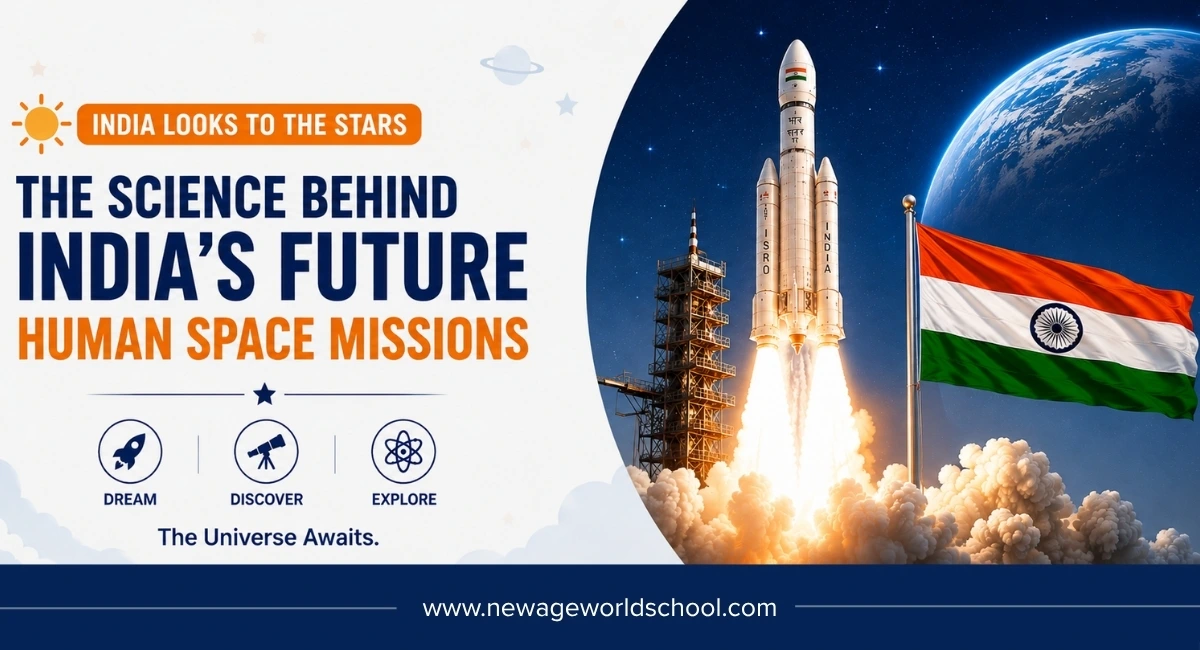
Table of content
Introduction
Why Is Space Difficult for Humans?
What Happens to Our Body in Space?
Becoming an Astronaut Takes Preparation
How Do Astronauts Get Food, Water and Oxygen?
The Science Behind the Spacecraft
Where Do Biology, Chemistry and Mathematics Fit In?
What Can Students Learn From India's Space Programme?
Looking Towards the Future
India Looks to the Stars: The Science Behind India’s Future Human Space Missions
When we look at the night sky, it is natural to wonder what is beyond the stars and planets we can see. As children, many of us have probably imagined becoming astronauts or travelling to space. Today, such dreams are becoming closer to reality, especially as India works towards human spaceflight through its Gaganyaan programme.
As a Science Teacher, I find this topic particularly exciting because it shows students that the science they learn in their classrooms has a much bigger purpose. Concepts from Biology, Physics, Chemistry and Mathematics are all connected when it comes to sending humans safely into space.
But have you ever wondered what it actually takes to send a person beyond Earth?
Why Is Space Difficult for Humans?
Our planet gives us everything we need to live. We have air to breathe, water to drink, food to eat and an atmosphere that protects us. In space, none of these things can be taken for granted.
Astronauts need a spacecraft that can provide a safe environment throughout their journey. It must supply oxygen, maintain suitable temperature and pressure, remove carbon dioxide and deal with waste. It also needs systems that can protect the astronauts from the harsh conditions outside.
This makes space travel very different from travelling anywhere on Earth. There is very little room for mistakes when human lives are involved.
What Happens to Our Body in Space?
One of the things I find most interesting about human spaceflight is the effect of space on our bodies.
On Earth, gravity is always acting on us. We may not think about it while walking, sitting or even standing, but our bodies are constantly working against gravity. In space, astronauts experience microgravity, which makes them appear to float.
It may look enjoyable, but spending time in microgravity can affect the body. Muscles can become weaker, bones can lose density and astronauts can experience changes in balance and coordination. Body fluids can also shift towards the upper part of the body.
This is why astronauts need to exercise regularly during their missions. Their training is not only about preparing for the journey; it is also about keeping their bodies healthy while they are away from Earth.
For students, this is a simple example of how something they learn in Biology can become important in space science.
Becoming an Astronaut Takes Preparation
Being an astronaut is much more than simply travelling in a spacecraft. Astronauts have to be prepared physically and mentally for situations that may be unfamiliar or difficult.
Their training can include physical exercises, simulations, emergency procedures and learning how different spacecraft systems operate. They need to know what to do if something goes wrong and, most importantly, how to remain calm and make the right decisions.
Astronauts also need scientific and technical knowledge. During a mission, they may conduct experiments, operate equipment and communicate with people on Earth.
And they are never working alone. A successful space mission depends on a huge team of scientists, engineers, doctors, technicians and many other professionals working together.
How Do Astronauts Get Food, Water and Oxygen?
Even everyday activities such as eating and drinking need careful planning in space.
Food has to be nutritious and safe, but it also needs to be suitable for storage and consumption in microgravity. Water has to be used carefully because carrying large quantities into space is difficult.
Oxygen is even more important. Astronauts need a constant supply of breathable air, while carbon dioxide produced when they breathe has to be removed from the spacecraft.
These are problems that we rarely think about in our daily lives. We simply turn on a tap for water or breathe the air around us. In space, however, these basic needs require carefully designed systems.
The Science Behind the Spacecraft
A human space mission also depends on complex engineering.
The launch vehicle needs to generate enough thrust to carry the spacecraft away from Earth. The crew module must provide a safe environment for the astronauts, while other systems take care of communication, navigation, power, temperature and life support.
The return journey is another major challenge. When the spacecraft enters Earth's atmosphere at very high speed, it experiences tremendous heat. A heat shield is therefore essential to protect the crew module and the people inside it.
This is where Physics comes alive. Ideas such as force, motion, energy, heat, pressure and gravity are not simply topics in a textbook. They are part of the calculations and decisions involved in designing a spacecraft.
Where Do Biology, Chemistry and Mathematics Fit In?
Human spaceflight is a good reminder that science does not always work in separate boxes.
Biology helps us understand how the human body responds to microgravity, how astronauts should exercise and what they need to stay healthy.
Physics helps us understand motion, gravity, forces, energy and heat.
Chemistry is important for life-support systems, fuels and the materials used in spacecraft.
Mathematics helps scientists and engineers calculate distances, speeds, trajectories and many other measurements.
When we put all these areas together, we begin to understand just how much knowledge and effort goes into a single space mission.
What Can Students Learn From India's Space Programme?
Perhaps the biggest lesson for our students is the importance of curiosity.
Most scientific discoveries begin with a question. Someone wonders why something happens or asks, “Can we find a better way?” That curiosity leads to experiments, research and eventually new discoveries.
Sometimes students feel that Science is mainly about remembering definitions, drawing diagrams or preparing for examinations. But space exploration gives us a different picture of science. It shows us that science is also about asking questions, solving problems, learning from failure and trying again.
A student who enjoys Biology could one day work in space medicine. A student interested in Physics could become an aerospace engineer. Someone who enjoys computers could work on spacecraft software or robotics. We cannot know where a child's curiosity will eventually take them.
Looking Towards the Future
India's progress towards human spaceflight is an exciting development for all of us, but I believe it is especially meaningful for young learners.
As teachers, we have the opportunity to show children that the lessons they learn today can become part of something much bigger tomorrow. A simple lesson about gravity, the human body or energy can eventually connect to real scientific work.
Perhaps some of today's students will one day become scientists, engineers, doctors or astronauts. Perhaps they will work on missions that take humans farther into space or develop technologies that we cannot yet imagine.
For now, we can encourage them to stay curious, ask questions and never be afraid to explore an idea.
The universe is vast, and there is still so much we do not know.
India's journey towards human spaceflight is not only about reaching space. It is also about inspiring the next generation to learn, question, explore and dream beyond what seems possible.
At NewAge World School, we believe education should go beyond textbooks. We encourage students to ask questions, explore ideas, think scientifically and develop the confidence to dream big. With a learning environment that supports curiosity, creativity and real-world understanding, we help young minds prepare for the opportunities of tomorrow.
Admissions are now open. Explore our Admission Process or Apply Now to begin your child’s learning journey with NewAge World School.
Frequently Asked Questions
What subjects are important for a career in space science?
Biology, Physics, Chemistry and Mathematics all play a important role.
What can students learn from India's space programme?
The biggest lesson is the value of curiosity — asking questions, solving problems and learning from failure. Students interested in Biology, Physics or technology can explore future careers in space medicine, aerospace engineering or robotics.

NewAge World School







Leave a Reply
Your email address will not be published. Required fields are marked *
Comments
No comments available