Skill Development Through the ICSE Curriculum: Preparing Students for Life Beyond the Classroom
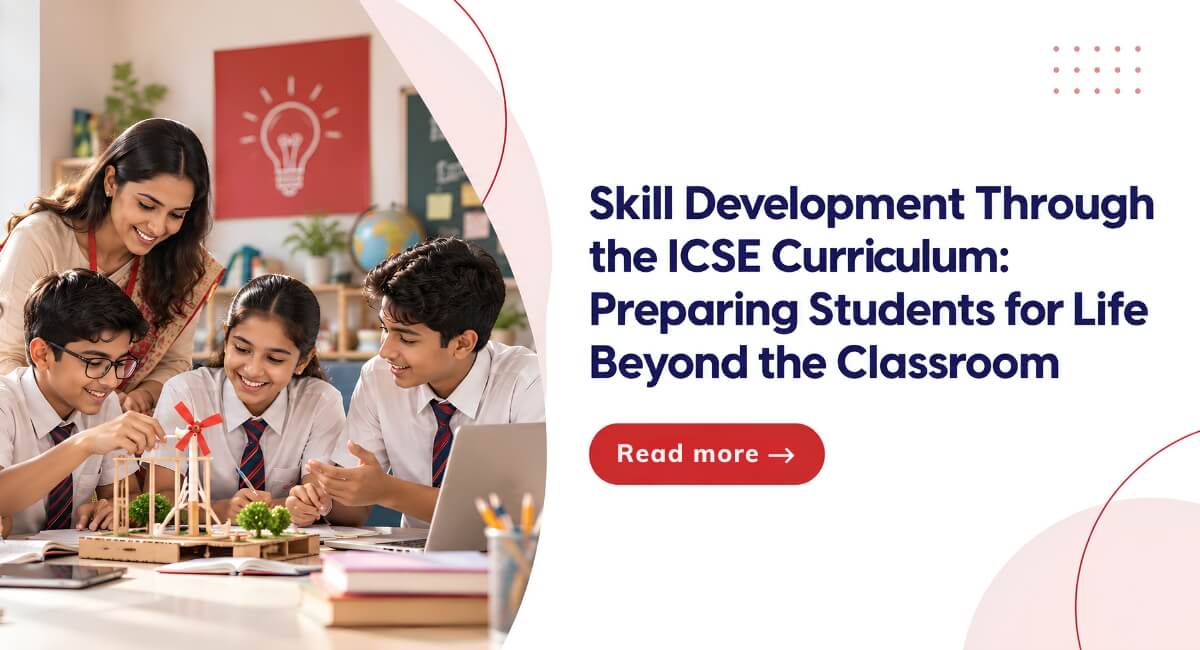
Table of content
- Introduction
- What Does Skill Development Mean in School Education?
- How the ICSE Curriculum Supports Skill Development
- Competency-Based Education in ICSE
- Developing Critical Thinking and Problem-Solving Skills
- Communication Skills Through Languages and Classroom Learning
- How Projects Build Practical Learning Skills
- Collaboration, Teamwork and Social Development
- Creativity and Independent Thinking
- Digital Literacy and Technology Skills
- Life Skills in ICSE Curriculum
- How the Curriculum Builds Future-Ready Students
- How Parents Can Support Skill Development at Home
- Education That Goes Beyond the Classroom
- Give Your Child a Strong Foundation for the Future
- Frequently Asked Questions
Introduction
Education today is not only about remembering lessons, writing examinations and getting good marks. Children are growing up in a world where they will need to communicate clearly, solve problems, work with different people, use technology wisely and make responsible decisions.
This is why parents are increasingly looking at what children learn beyond textbooks. A strong international school education should help students understand academic subjects while also developing the confidence and skills needed in everyday life.
Skill development in ICSE curriculum supports this broader approach to learning. The Council for the Indian School Certificate Examinations, or CISCE, places increasing importance on understanding, application, communication, creativity, reasoning and competency-based learning. Its curricular guidance includes skills such as oral and written communication, scientific thinking, digital literacy, teamwork, logical reasoning, creativity and vocational exposure.
For students, this means learning can become more connected to real situations. Instead of simply asking, “Can I remember the answer?”, students are encouraged to think, “Can I understand this idea and use it when I need it?”
What Does Skill Development Mean in ICSE School Education?
Skill development means helping students learn how to use knowledge effectively. Knowing a fact is useful, but knowing when, why and how to use that fact is equally important.
For example, a child may know the formula required to solve a Mathematics problem. Skill-based learning goes a little further. It encourages the child to understand the problem, decide which method can be used, complete the calculation and check whether the answer makes sense.
The same approach can be seen in languages, science, social studies and other subjects. Students may be asked to explain their views, analyse information, conduct an activity, prepare a project or connect a classroom concept with something happening around them.
This type of learning gradually develops confidence and independence. Children begin to understand that education is not only about giving the expected answer. It is also about learning how to think.
How Does the ICSE Curriculum Support Skill Development?
The ICSE learning framework covers academic knowledge while also giving importance to several abilities that students can use beyond school. CISCE's curricular integration guidance identifies communication, evidence-based thinking, creativity, digital literacy, coding, computational thinking, collaboration, teamwork, problem solving, logical reasoning, environmental awareness, ethical reasoning and vocational exposure among important skills and capacities. This makes skill development in ICSE curriculum a process that can take place across different subjects rather than being limited to one separate class.
A Science lesson, for example, can encourage observation and evidence-based thinking. English can strengthen communication and interpretation. Mathematics develops reasoning and accuracy. History and Civics can encourage students to understand different viewpoints, social responsibilities and citizenship. When international schools teach these subjects through discussion, questioning, projects and application, children begin to develop abilities that support them in real-life situations too.
Competency-Based Education in ICSE: Learning Beyond Memorisation
One important shift in modern education is the growing focus on competency. Competency means being able to apply knowledge and skills in a meaningful situation. A student may remember a chapter very well, but competency-based learning asks whether the student can understand the concept, analyse information and use what has been learned to solve a question.
CISCE has taken steps towards competency-based education in ICSE through competency-focused assessment. The Council states that competency-focused questions have been incorporated at ICSE and ISC levels from the examination year 2024. These questions aim to develop areas such as understanding, application, analysis, evaluation, creativity and higher-order thinking.
This approach can help reduce dependence on rote memorisation. Students still need strong subject knowledge, but they also need to know how to use that knowledge. For example, a Geography question may ask a student to study data and draw a conclusion instead of simply recalling a definition. A Science question may present a real situation and ask the student to apply a concept. A language task may ask the learner to understand meaning, form an opinion and communicate it clearly.
CISCE provides further information on this teaching approach through its official competency-based education material. CISCE Competency-Based Education Resource
Developing Critical Thinking and Problem Solving in ICSE
One of the most useful abilities a child can develop is the habit of thinking before accepting an answer. Critical thinking and problem solving in ICSE can develop when students are encouraged to compare information, identify patterns, ask questions, examine evidence and choose a suitable solution.
These abilities matter far beyond examinations. Imagine a student planning a school project. The child must first understand the task, gather information, decide which sources are useful, organise the work and present it clearly. If something does not work as expected, the student needs to find another approach.
This simple project involves decision-making, reasoning, creativity, time management and communication. CISCE's upper-primary curriculum also describes critical thinking and problem solving in terms of reasoning, making choices, understanding connections, analysing information and combining ideas. These skills become valuable later in higher education, careers and everyday decision-making.
Communication Skills Through Languages and Classroom Learning
A student may have excellent ideas, but those ideas become more useful when the student can express them clearly. Communication includes speaking, listening, reading, writing and understanding another person's point of view. These abilities develop naturally when students participate in classroom discussions, presentations, written assignments, debates and language activities.
A good language education does more than teach grammar. Students learn how to organise thoughts, choose appropriate words and communicate with confidence. Listening is equally important. Students need to understand instructions, pay attention to different opinions and respond thoughtfully.
Strong communication skills can help children participate more confidently in class. Later, the same skills are useful during interviews, college presentations, professional discussions and everyday conversations.
How Projects Build Practical Learning Skills
Project work can turn classroom knowledge into practical learning. Instead of only reading information from a textbook, students may research a topic, collect information, organise their findings and present what they have understood. This process encourages learners to take more responsibility for their work.
Project-based learning can also improve planning and time management. A student has to understand the deadline, divide the task into manageable parts and complete each part carefully. ICSE regulations include internal assessment components involving assignments, project work, practicals and course work across subjects.
When project work is treated as a genuine learning experience rather than only a task for marks, it can strengthen research skills, creativity, organisation and independent learning.
Collaboration, Teamwork and Social Development
Children will not work alone throughout their lives. Whether they enter science, business, technology, design, medicine or another profession, they will need to interact and work with other people. Team activities at international ICSE school teach children how to share responsibility and listen to different ideas.
A group project may appear simple, but many important skills are being developed. Students learn to divide work fairly, communicate with team members, manage disagreements and complete a shared goal. Teamwork also teaches children that another student's idea may be different without being wrong. These experiences support some of the most valuable life skills in ICSE curriculum, including cooperation, communication, empathy and responsibility.
Creativity and Independent Thinking
Creativity is not limited to drawing, music or art. It also means being able to imagine different possibilities and find new ways to approach a problem. A creative student may think of another method for solving a Mathematics question, suggest an unusual idea during a Science project or present a familiar topic from a fresh point of view.
Schools can develop creativity by giving students space to ask questions and experiment with ideas. This is especially useful because real-life problems do not always come with one ready-made answer. Students who learn to explore possibilities become more comfortable when they face new situations.
Creativity, curiosity and logical thinking work well together. Curiosity makes students ask questions, reasoning helps them examine the situation and creativity allows them to explore possible answers.
Digital Literacy and Technology Skills
Technology has become a normal part of education, work and everyday communication. Students today need more than the ability to operate a device. They should gradually learn how to search for information, judge whether a source is reliable, communicate responsibly online and use digital tools for productive work.
CISCE's curricular framework includes digital literacy, coding and computational thinking among essential skills and capacities. These abilities are becoming increasingly important as technology changes the way people learn and work.
However, good digital education should also help children understand responsibility. Students need to know that everything available online may not be accurate. They should learn to check sources, protect personal information and use technology thoughtfully.
Life Skills in ICSE Curriculum: Preparing Students for Everyday Situations
Academic learning is important, but children also need abilities that help them manage everyday challenges. Life skills in ICSE curriculum can be developed through classroom learning, group activities, projects, sports, discussions and daily interactions within the school environment.
Children gradually learn how to manage their time, express themselves respectfully, take responsibility for their work and respond to mistakes in a healthy way. They also learn that improvement takes practice. A difficult Mathematics problem, an unsuccessful experiment or a challenging presentation can teach patience and persistence when students receive the right guidance. These experiences help students become more confident and responsible learners.
How the Curriculum Builds Future-Ready Students
Nobody can predict exactly what every profession will look like when today's children enter the workplace. Technology, industries and the way people work are changing quickly. This makes adaptable skills especially valuable.
Future-ready skills for students include communication, critical thinking, problem solving, creativity, teamwork, digital literacy, self-learning and adaptability. These abilities help students continue learning even when situations change.
India's National Education Policy 2026 also emphasises moving education towards understanding and learning how to learn rather than depending heavily on rote learning. It highlights critical thinking, problem solving, communication, teamwork and other social and emotional abilities as important parts of holistic education.
For parents who would like to explore the strategic vision behind these educational reforms, the complete text is available in the National Education Policy issued by the Ministry of Education. The real value of future-ready education is not preparing a student for one particular job. It is preparing the learner to understand new situations, keep learning and make thoughtful decisions.
How Parents Can Support Skill Development at Home
Parents can encourage children to explain how they reached an answer instead of asking only whether the answer is correct. Conversations about books, news, nature or daily experiences can encourage observation and independent thinking.
Children can also be given age-appropriate responsibilities at home. Planning their study time, arranging their materials, helping organise an activity or managing a small task can improve responsibility and decision-making.
When children make mistakes, parents can discuss what happened and what could be done differently next time. This helps them see mistakes as part of learning rather than something to fear.
Education That Goes Beyond the Classroom
Education should help children succeed in examinations while also preparing them to handle life with confidence and curiosity. Skill development in the ICSE curriculum can support this goal by connecting academic learning with communication, reasoning, creativity, teamwork and practical application. The increasing focus on competency-based learning also encourages children to understand what they study instead of depending only on memorisation.
When students learn how to ask questions, analyse information, communicate clearly and solve problems, they begin developing abilities that stay useful long after a particular chapter or examination is over.
Parents can support this journey by choosing a school environment where academic learning and personal growth receive equal attention. With the right guidance, students can grow into thoughtful learners who are ready not only for the next examination, but also for the opportunities and challenges that come after school.
Give Your Child a Strong Foundation for the Future
Admissions are now open for parents looking for a learning environment that encourages academic excellence along with communication, creativity, critical thinking, confidence and practical skills. A good school experience should help children understand concepts, explore their interests and gradually become independent learners who are prepared for life beyond the classroom.
Book a school tour today to meet the educators, explore the learning environment and understand how the school supports your child's academic and overall development.
Frequently Asked Questions
Are academic marks still important in skill-based education?
Academic achievement remains important, but marks are only one part of a child's development. A well-rounded education should also help students understand concepts, communicate ideas, work independently and apply knowledge when facing new situations.
Why are future-ready skills important for students?
Future-ready skills help children handle situations that may change with time. Communication, adaptability, digital literacy, teamwork, creativity and problem solving can support students during higher education, careers and everyday life.
How does ICSE help students develop communication skills?
Language learning, classroom interaction, assignments, presentations, discussions and project work can provide regular opportunities for students to practise listening, speaking, reading and writing. These experiences gradually help learners communicate with greater clarity and confidence.
What is competency-based education in ICSE?
Competency-based education focuses on whether students can understand and apply what they have learned. Instead of depending only on memorisation, learners are encouraged to use concepts in questions, situations and problems that require reasoning and application.
Does the ICSE curriculum encourage critical thinking?
Yes. CISCE's competency-focused approach encourages students to understand, analyse, apply, evaluate and think beyond simple recall.
What is skill development in the ICSE curriculum?
Skill development in the ICSE curriculum refers to developing abilities such as communication, critical thinking, problem solving, creativity, teamwork, digital literacy and practical application along with academic knowledge. CISCE's curricular guidance includes many of these skills and capacities as part of a broader learning approach.
NewAge World School





Leave a Reply
Your email address will not be published. Required fields are marked *
Comments
No comments available