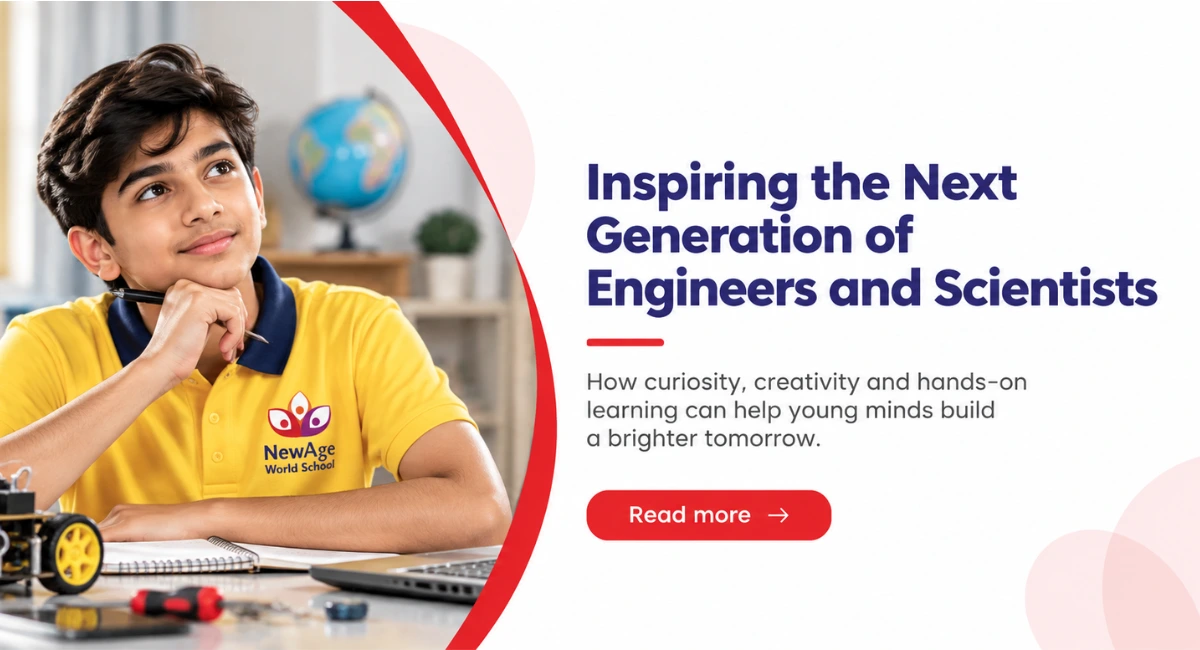
Inspiring the Next Generation of Engineers & Scientists

Table of content
Introduction
Inspiring the Next Generation of Engineers and Scientists
Conclusion
Introduction
Curiosity is one of the most powerful forces behind learning, discovery, and innovation. From an early age, children naturally ask questions about how things work, why events happen, and what might be possible if some things were done differently. Instead of discouraging these questions, educators, parents, and communities should encourage young learners to explore. When students are given the freedom to ask questions, investigate unfamiliar ideas, and consider different solutions, they gradually develop the confidence and intellectual independence needed to become thoughtful problem-solvers.
Inspiring the Next Generation of Engineers and Scientists
The development of young engineers and scientists is not simply about teaching formulas, definitions, or technical procedures. Scientific knowledge provides an important foundation, but future innovators also need imagination, persistence, communication skills, critical thinking, and the willingness to experiment. A student who understands a scientific principle but is afraid to make mistakes may struggle to apply that knowledge creatively. Conversely, a learner who is encouraged to experiment and learn from unsuccessful attempts can develop the resilience required for meaningful innovation.
Experiential learning can play a powerful role in preparing students for the future. Students often understand concepts more deeply when they can connect what they learn in the classroom with practical, real-world experiences. Activities such as developing a water-filtration model, creating a solar-powered device, observing plant growth are more engaging and meaningful.
The benefits of these activities go far beyond the final project. While working on a practical task, students may find that their first idea does not work as planned. Instead of seeing this as a failure, they learn to identify problems, rethink their approach, test new ideas, and improve their designs. This process helps develop creativity, problem-solving abilities, critical thinking, patience, and confidence. By giving students opportunities to learn through experimentation and hands-on projects, education can move beyond memorising information. It can encourage students to become curious thinkers and active problem-solvers who are better prepared to apply their knowledge in real-life situations.
Project-based learning can also strengthen collaboration. Modern scientific and engineering achievements are rarely the result of one person working entirely alone. Giving students opportunities to work in teams teaches them how to communicate ideas, listen to different perspectives, divide responsibilities, resolve disagreements, and combine individual strengths.
Another important element in inspiring young scientists and engineers is exposure to meaningful role models. Students benefit from learning about people who have contributed to science, technology, engineering, and mathematics and understanding the challenges they encountered along the way.
Understanding the role of failure is particularly important. Young people may sometimes believe that successful individuals achieve their goals because they are naturally talented and rarely make mistakes. In reality, innovation is often a process of trial and error. An unsuccessful experiment can reveal valuable information. Teaching students to view setbacks as opportunities to learn can help them develop resilience and a growth-oriented attitude.
Schools play a central role in creating environments where this kind of learning can thrive. Traditional classroom teaching remains important, and can be supported by science exhibitions, laboratory activities, mathematics challenges. These opportunities give students a chance to explore subjects beyond the limits of textbooks and discover areas that genuinely interest and inspire them.
Teachers can further encourage curiosity by creating classrooms where students feel comfortable asking questions. A student should not feel embarrassed for proposing an unusual idea or giving an incorrect answer. Instead, teachers can use questions and mistakes as starting points for discussion. Asking students to explain how they reached a conclusion, compare different approaches, or predict what might happen in an experiment can encourage deeper thinking rather than simple memorization. Not every child has access to sophisticated laboratories or expensive equipment, but curiosity can be encouraged through simple activities using everyday materials. Observing the night sky, growing plants, repairing household objects, measuring changes in temperature can all become opportunities for scientific thinking. What matters most is not always the complexity of the equipment but the quality of the questions being explored.
Equal access to STEM opportunities is another important consideration. Students from different social, economic, and geographical backgrounds should have opportunities to participate in scientific and technological learning. Libraries, community centres, schools, universities and science organizations, can help broaden access to resources and guidance. Providing opportunities to students who might otherwise have limited exposure to STEM can uncover talent that might otherwise remain unnoticed.
Creativity is equally important. Engineering is sometimes viewed as a purely mathematical discipline, while science is sometimes presented as a collection of established facts. In reality, both fields require imagination. Young learners should therefore be encouraged to look at ordinary problems from new perspectives. A leaking tap can become a lesson in water conservation. Excessive electricity consumption can inspire an energy-monitoring project. Difficulties in carrying school materials can lead to the design of a more efficient storage system. Local environmental challenges can become opportunities to investigate waste management, renewable energy, water quality, or sustainable construction. When students understand that STEM knowledge can be used to address real problems, learning becomes more relevant and purposeful. The connection between STEM education and responsible citizenship should also be emphasized. Future engineers and scientists will make decisions that can influence communities and the environment.
The ability to learn continuously may become one of the most valuable skills of all. Scientific knowledge changes as new evidence is discovered, and technological tools evolve rapidly. Young people who learn how to research, evaluate information, ask meaningful questions, and acquire new skills independently will be better prepared to adapt to these changes. Curiosity, in this sense, becomes more than an educational quality; it becomes a lifelong advantage.
Inspiring the next generation of engineers and scientists is ultimately a shared responsibility. Schools can provide structured learning and opportunities for experimentation. Families can nurture curiosity at home. Communities can create spaces for collaboration and discovery. Most importantly, young people need to believe that their ideas matter. A child who asks an unexpected question today may become a researcher who solves an important scientific problem tomorrow. A student who builds a simple model may eventually design technology that improves people's lives. An unsuccessful school project may be the first step toward learning how to approach a much larger challenge.
Conclusion
The future of science and engineering will depend not only on technological progress but also on the people who have the courage to imagine what comes next. By encouraging curiosity, supporting experimentation, welcoming questions, celebrating creativity, and treating failure as part of learning, society can help young people develop into confident problem-solvers and responsible innovators.
The next important invention, scientific discovery, or technological breakthrough may already be taking shape in the mind of a young learner. What that idea becomes will depend partly on whether that learner receives the encouragement, resources, guidance, and opportunity to explore it.

Sandra Calvin | Mathematics Teacher






Leave a Reply
Your email address will not be published. Required fields are marked *
Comments
No comments available